
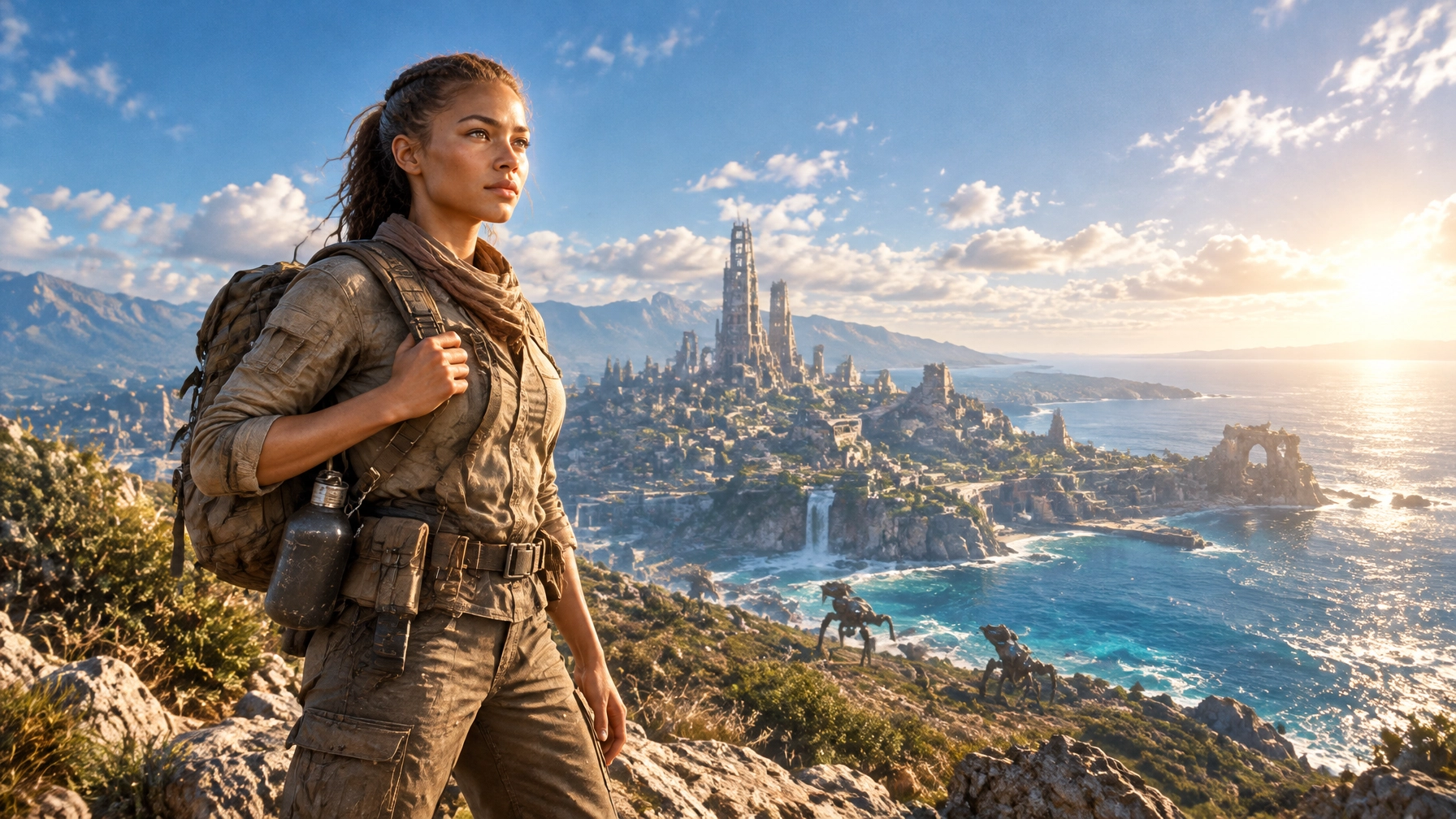
A graphic novel and a film can share a world without telling a story in the same way. One invites us to pause over an image, follow the space between panels, and imagine what happens next. The other moves through performance, sound, editing, and time. The challenge of a graphic novel to film adaptation is not to copy every page. It is to carry the story’s heart into a new form.
That idea sits at the center of Deborah Pratt’s transmedia universe. Warrior One is a graphic novel thread woven through the larger Vision Quest novel series. The stories inhabit the same world, but each can reveal a different side of it. As the universe extends toward television and feature film, the opportunity is not to repeat what readers have already seen. It is to deepen their connection to the same human story.
Begin with the heart, not the panels
In Warrior One, we meet Jetta A, a young woman whose life changes when the Black Guard attacks her home. Separated from her family, she must learn how to survive, and decide what kind of person she will become.
That emotional journey is the story’s anchor. The world around Jetta is expansive: the Great Quakes have reshaped Earth, Atlantia has risen, and biologically based machines have become sentient. But the audience does not need to understand every part of that history before they care about her. They need to feel what she has lost, what she fears, and what she chooses to do next.
For a screen adaptation, this is a practical compass. When a scene, character, or piece of world-building competes for attention, return to Jetta’s point of view. Does it bring us closer to her experience? Does it change what she wants, fears, or understands? If not, the story may not need it in that moment.

Translate the storytelling, not the frame
A graphic novel can place an intimate close-up beside a vast landscape and let the contrast speak for itself. It can use a page turn to create a reveal. A recurring image or color can quietly gather meaning across many panels.
Film has its own language. A close-up can hold on a face as an actor searches for a response. A quiet stretch of sound can make a landscape feel enormous. Editing can move between danger and memory in a way that shapes how we experience a moment.
The job is to ask what a panel does, then find a cinematic way to do that. A page-turn reveal might become a slow approach through a doorway. A sequence of survival images might become one continuous scene in which we watch Jetta assess the terrain, protect her supplies, and decide where to go. The details will change, but their purpose can remain.
This is why faithful adaptation does not mean literal reproduction. The screen version can keep the emotional and thematic spine while finding a fresh rhythm. Its aim is to help an audience feel what the page made readers feel, through the distinct strengths of film.
Let survival carry the story
Jetta’s practical needs make her transformation visible. She has to find water, food, and shelter. She must learn how to use what she has, judge the risks around her, and keep moving. These are not pauses between the important scenes. They are important scenes, because each choice reveals how Jetta is changing.
A film can turn such moments into a steady emotional progression. At first, a task may leave her unsure. Later, she may handle it with greater confidence, or make a difficult choice that shows how much the world has asked of her. Survival becomes character development the audience can see and feel.
Keeping the world grounded helps, too. Functional equipment, worn materials, changing weather, and demanding terrain give the future a physical reality. Technology belongs in the story, but it should feel like part of the characters’ lives: useful, imperfect, and shaped by human choices. The result can be realistic science fiction that still leaves room for awe.

Give the larger universe room to breathe
Warrior One is connected to The Vision Quest, but it does not need to carry the entire universe on its shoulders. The novel series follows a wider journey through a changing Earth and the promise of the Age of Light. The graphic novel brings us close to Jetta’s fight. A screen story can reveal another part of that same world without turning into a summary of everything that came before.
That distinction matters in transmedia storytelling. Each form should offer a meaningful experience on its own. A reader should be able to enter through the graphic novel and follow Jetta’s journey. A viewer should be able to meet the world through a film or series and feel a complete emotional arc. Longtime readers can find added resonance in familiar places, ideas, or connections, but new audiences should never feel they need a guidebook to care.
This approach creates space for discovery. The graphic novel can make one part of the universe vivid; a television series can explore another character’s path over time; a feature film can shape a focused, cinematic passage. The universe grows not by repeating itself, but by letting each doorway open onto something new.
Protect the hope
The Black Guard’s rise creates real danger, but danger is not the only promise of the story. At the heart of the Vision Quest universe is a belief in human potential: the idea that people can learn, change, work together, and meet a difficult future with courage.
That hope is not a shortcut around conflict. It becomes meaningful because the characters face hard choices. Jetta’s courage matters because she is frightened. Her leadership matters because survival is not only about protecting herself; it is also about deciding how to stand with others. The Age of Light is more than a bright horizon. It is something people build through their actions.
On screen, that philosophy can live in specific choices: who receives help, what knowledge is shared, and whether fear leads characters to turn away from one another or to work together. Those moments make the future feel possible, not perfect, but worth moving toward.
A practitioner’s view of adaptation
Deborah Pratt brings the perspective of a veteran Black female science-fiction creator whose career spans decades of television writing and producing. That experience matters when a story moves between forms. Television and film ask creators to think about pace, visual clarity, performance, and how much an audience can absorb in a single scene. A transmedia universe also asks a larger question: what can this version contribute that the others cannot?
The answer begins with a clear sense of what must remain. For Warrior One, that means Jetta’s point of view, her personal stakes, the physical reality of survival, and the belief that human beings can rise to meet a changed world. Around that center, the screen story can make new choices. It can find new images, sounds, relationships, and rhythms, and still feel true.

One world, more than one way in
A strong graphic novel to film adaptation does not ask, “How can we put every panel on screen?” It asks, “What is the heart of this story, and what can the screen reveal about it?”
For Warrior One, the graphic novel carries one side of the world: Jetta’s close, hard-won path from loss toward leadership. A screen version can keep that heart while allowing us to experience the world through movement, sound, faces, and time. The larger Vision Quest universe gives both forms room to connect without making them identical.
That is the promise of transmedia storytelling: not one story copied across platforms, but a living world with more than one meaningful entrance. Each version can stand on its own, add something new, and point toward the same hopeful horizon.
Explore Warrior One and The Vision Quest to discover more of Deborah Pratt’s universe. For more information, contact Warrior One LLC.

